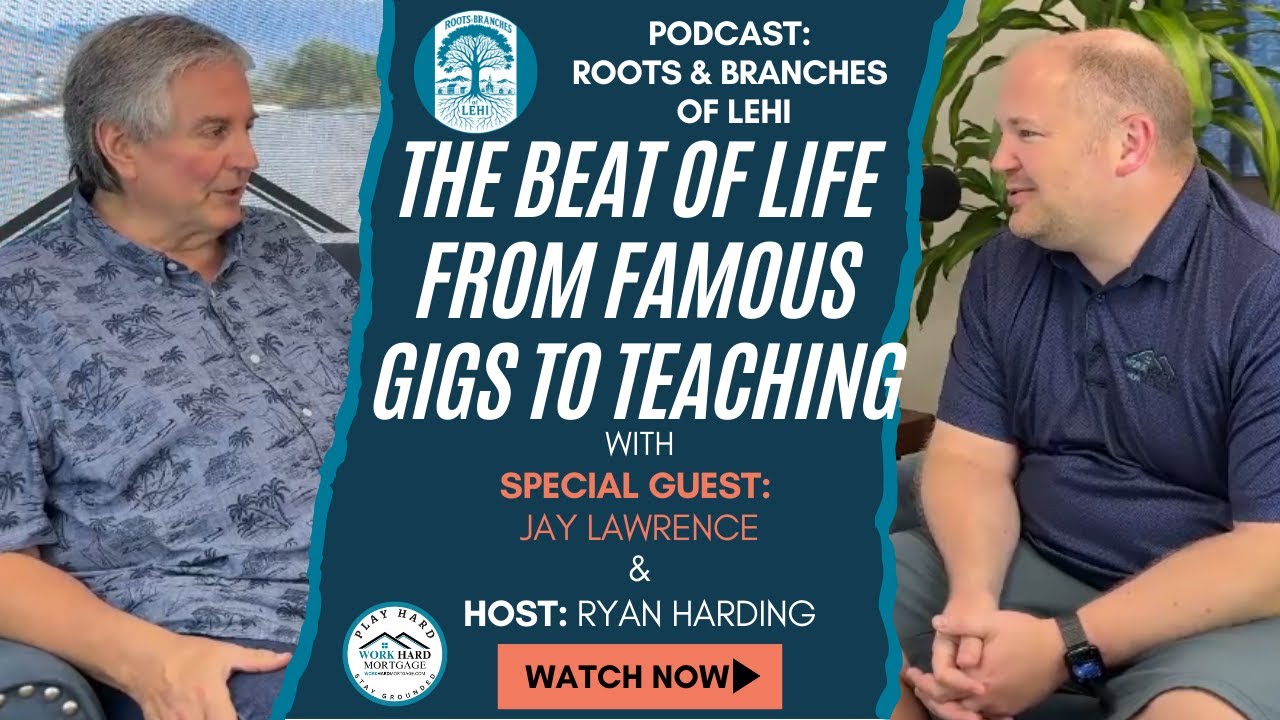
Drumming with Legends: Jay Lawrence Performing with Cher, Sammy Davis Jr. & Liberace
Professional drummer and educator Jay Lawrence reflects on a fifty-year career performing alongside global icons while maintaining a life of deep faith and community in Lehi.
Jay Lawrence
Professional Drummer, Composer, and Teacher
At a Glance
Archive Scoring
Introduction
In this archival record, Jay Lawrence documents the rhythmic cadence of a life split between the high-stakes showrooms of Reno and the steady, faith-centered community of Lehi, Utah. His story serves as a bridge between the golden era of live entertainment—where a sixteen-year-old could find himself backing world-class celebrities—and the modern era of musical education and digital composition. Lawrence offers a profound meditation on the concept of 'versatility' as both a professional necessity and a life philosophy, illustrating how he navigated the potential pitfalls of the music industry by rooting himself in his religious convictions.
Central to this history is the theme of mentorship. Lawrence recounts his intensive apprenticeship under Jerry Janeiro, which transformed a teenage obsession into a disciplined craft. This legacy of learning came full circle as Lawrence spent decades teaching at every major higher-education institution in Utah, including BYU and the University of Utah. He describes the transition from performer to educator as a process of deep internal organization, where the 'six prongs' of drumming became a framework for passing on wisdom to the next generation.
Beyond the drums, Lawrence discusses his evolution as a composer of both popular and sacred music. His work on 'Empty Pit' Broadway tracks highlights the technological shift that altered the landscape for live musicians, while his award-winning hymns represent a spiritual synthesis of his professional skill and personal devotion. The narrative captures a specific moment in Western American history when the entertainment hubs of Nevada began to influence the cultural and educational landscape of Utah.
Ultimately, Lawrence’s testimony is one of balance. He articulates the delicate interplay between the 'frosting' of fame and the 'cake' of hard work and family. His choice to stay in Lehi, despite a career that could have taken him to Los Angeles or New York, speaks to the value of place and the importance of deepening one's roots even while reaching for international branches of success.
Episode Overview
A detailed look at the topics, people, and context of this conversation.
This episode features Jay Lawrence, a professional drummer, composer, and teacher who has been a resident of Lehi for over 21 years. The conversation spans his early beginnings in Reno, Nevada, where he joined the Musicians Union at age 15 and began playing two shows a night for legends like Cher, Sammy Davis Jr., and Liberace. Lawrence provides a rare look at the 'house band' culture of the 1970s and 80s, detailing the rigor and humor of life on the road and in the casino showrooms.
As the narrative moves to Utah, the focus shifts to Lawrence's prolific career in education and recording. Having taught at BYU, the University of Utah, and Snow College for decades, he discusses his influential percussion textbook and his philosophy on 'musicianship'—a quality he believes encompasses listening, dynamics, and theory. The episode also explores his work in recording Broadway scores used worldwide and his successful foray into hymn composition for the LDS Church.
Through Ryan Harding’s hosting, the episode captures the emotional resonance of a man who has achieved the highest levels of professional success without losing his sense of gratitude or identity. It is a story of how a global career can be successfully integrated into a quiet life of community service and family devotion in Lehi.
Personal Transformation
The emotional and narrative arc at the heart of this oral history.
Jay Lawrence's narrative is a profound study in the evolution from singular obsession to multifaceted mastery and stewardship. He began as a teenager in Reno, Nevada, consumed by a singular, almost frantic desire to master the drums—an obsession that led him to cut school to practice and persistently petition a teacher who initially refused him. This early phase was characterized by a pursuit of technical prowess and the high-energy validation of the showroom stage, where he found himself out-earning his father before he was even an adult. At this stage, music was a vehicle for personal achievement and a gateway to a glamorous, high-stakes world.
A significant turning point occurred as the 'Golden Age' of live showroom orchestras began to wane due to technological shifts. Lawrence faced the reality of a fluctuating industry and the growing responsibilities of a large family. This necessitated a shift from being a 'performer-for-hire' to becoming a creator and educator. Moving to Utah, he transitioned into the academic world and the recording studio, realizing that his value lay not just in his ability to keep time, but in his ability to translate the language of music for others. This was a move from the spotlight of the stage to the light of the classroom and the quiet focus of the composition desk.
His transformation was further deepened by the integration of his faith with his professional life. Rather than seeing his LDS standards as a barrier to the 'sex, drugs, and rock and roll' lifestyle of his peers, he adopted them as a protective framework that allowed him to remain 'in the world but not of it.' This shift in perspective turned his career into a mission of balance. He moved from seeking the next big gig to seeking the 'Monument of Faith,' as his award-winning hymn suggests, finding a way to harmonize the sacred with the secular.
Ultimately, Jay Lawrence transformed from a gifted 'young gun' on the drum kit into a sage of the rhythm world. He became a man who views music as a holistic discipline—integrating technique, theory, and spirituality. His current identity is defined not by the legends he once backed, but by the legacy he is building through his students, his written books, and his compositions that will be sung in congregations for years to come. He has moved from the transience of the performance to the permanence of the record.
Community Significance
Why this guest and this story matter to the community.
Jay Lawrence represents the 'hidden excellence' that characterizes the modern era of Lehi, Utah. While the town is often recognized for its rapid tech growth, residents like Lawrence provide the cultural and artistic bedrock that prevents a community from becoming a mere bedroom suburb. As a world-class musician who has shared the stage with the likes of Cher and Sammy Davis Jr., his presence in Lehi elevates the local cultural capital, proving that one can reach the pinnacle of a global industry while remaining rooted in a tight-knit, family-oriented community.
His impact on the community is most visible through his 27-year tenure at BYU and his work at the University of Utah, where he has mentored countless local musicians. For the youth of Lehi and surrounding areas, Lawrence serves as a living bridge between the aspiration of a creative career and the reality of a stable, faith-filled life. He has filled a critical need for high-level mentorship, bringing the exacting standards of the Reno showrooms to the practice rooms of Utah County. Without his influence, many local percussionists would lack the direct lineage to the professional standards of the mid-20th-century entertainment industry.
Furthermore, Lawrence's service within his local religious community adds a layer of spiritual significance. By composing hymns and participating in local musical leadership, he strengthens the communal bonds through shared worship and artistic expression. His story reinforces the idea that Lehi is a place where professional ambition does not have to come at the expense of neighborly connection. He is not just a 'drummer from the coast'; he is a neighbor who uses his world-class talents to bless the immediate community.
Finally, Lawrence’s work with 'Empty Pit' and recording Broadway scores means that his artistry is likely heard in local theaters across the country, including those in Utah. He has played a silent but vital role in the accessibility of the arts, allowing smaller community theaters to provide high-quality musical experiences. In Lehi, he stands as a testament to the fact that a resident's 'branches' can reach around the globe while their 'roots' remain firmly planted in the local soil.
"Growing up in a small town, I learned that connections go beyond blood. They're built through shared experiences, friendships, and the moments we celebrate together."
— Ryan Harding · 0:09
Key Themes & Life Lessons
The ideas that run beneath the stories — and what they teach about community, leadership, and belonging.
Professional Musicianship
Music Education and Pedagogy
LDS Faith and Artistic Integrity
Evolution of the Entertainment Industry
Music Composition and Arranging
Balancing Career and Family
Community Memory in Lehi
Arts & Culture
Wisdom & Life Lessons
Jay Lawrence articulates the wisdom that 'teaching is the best way to learn.' His insight that explaining a concept forces an organization of 'disparate elements' is a profound takeaway for anyone in a leadership or mentorship role. It suggests that the highest level of mastery is reached only when one can simplify and transfer knowledge to others.
He also shares the wisdom of 'Finding the Joy.' Despite the grueling schedule of six gigs in a day or the exhaustion of long tours, his recurring theme is that music has been a 'joy' to him. This wisdom suggests that the secret to a long and successful career is maintaining a connection to the initial spark of love for the craft, ensuring that the work remains rewarding beyond the paycheck.
Finally, his life illustrates the wisdom of 'Sacred Balance.' His patriarchal blessing's advice to divide his time between priesthood, family, and music serves as a universal template for a well-lived life. The wisdom here is that fulfillment comes not from maximizing any one area, but from the intentional and sometimes difficult work of harmonizing all facets of the human experience.
Key Takeaways
- 1Early professional immersion can accelerate mastery, as seen in Lawrence's career beginning at age 15.
- 2Faith and religious standards can act as a safeguard against the common pitfalls of the entertainment industry.
- 3The shift from live showroom orchestras to recorded tracks (Empty Pit) reflects broader technological changes in theater.
- 4Teaching is a primary method for refining one's own understanding of a craft through the organization of concepts.
- 5Versatility in musical styles—from jazz and rock to Latin and religious—is essential for a long-term professional career.
Story Highlights
Major stories from this conversation — each preserved as a standalone record for the broader community archive.
Jay Lawrence recounts his rapid ascent into the world of professional music. After receiving a drum set for his 14th birthday, he became obsessed with practice, sometimes even cutting school to perfect his craft. At age 15, he joined the American Federation of Musicians union. By age 16, he was performing two shows a night in Reno showrooms for global icons like Cher, Sammy Davis Jr., and Liberace. He recalls a poignant moment where he held a weekly paycheck for $600 in 1973—more than his father made in a month—which solidified his lifelong commitment to the music business.
Emotional Significance
There is a sense of youthful wonder mixed with professional gravitas; Jay felt the 'frosting on the cake' of the lights and celebrities, but deeper down, he felt the immense reward of meeting a high professional challenge.
Why This Matters
It documents the specific historical era of the Reno/Tahoe showroom circuit, which was a unique training ground for musicians that no longer exists in the same way.
Life Lesson
Exceptional focus and early dedication can open doors to world-class opportunities, but one must be prepared to work twice as hard as those around them to keep their seat at the table.
Transformation
Jay transformed from a typical teenager into a professional peer of seasoned musicians, learning to navigate adult environments and high-stakes performances before he had even graduated high school.
What It Reveals About Jay Lawrence
He possesses a rare 'obsession' for his craft and a fearless approach to high-pressure situations.
What It Reveals About the Community
Lehi is home to residents with deep professional legacies who bring a high standard of excellence to the local culture.
Community Value Preserved
The value of professional excellence and the historical record of the 1970s entertainment industry.
For future generations: It shows that talent and discipline are not bound by age; a young person with enough drive can influence and contribute to the highest levels of their industry.
While working in the high-intensity, often hedonistic environment of casinos and showrooms, Jay Lawrence maintained his standards as a member of the Church of Jesus Christ of Latter-day Saints. Surrounded by substance abuse, he never tasted alcohol. He shares a story of a bartender who complained that Jay's refusal of drinks was 'costing him money' when patrons bought rounds for the band. In response, Jay began ordering tonic water with lime—a 'sophisticated' looking drink that allowed him to participate in the social ritual without compromising his faith or health.
Jay recounts his pursuit of drum teacher Jerry Janeiro. Jay asked Janeiro for lessons multiple times, only to be rejected repeatedly. Finally, after the fourth or fifth attempt, Janeiro agreed, realizing Jay truly wanted to learn. This led to an intensive mentorship where Jay would pay $5 for lessons that lasted three and a half hours. Janeiro would go through a dozen books and then play records for Jay to analyze, providing the foundational training that allowed Jay to succeed in world-class showrooms.
Jay shares a personal and sacred detail regarding his Patriarchal Blessing, which mentioned his future in music. The blessing promised that if he divided his time between priesthood responsibilities, family, and musical opportunities, music would be a 'joy' to him. Jay reflects on his life, noting that while balance was a constant struggle and some days he failed, the overarching narrative of his career has been one of fulfillment rather than the burnout often seen in professional musicians.
As live showroom bands began to 'dry up' due to cost and technology, Jay Lawrence adapted by becoming a recording artist for Broadway scores. He worked with a company called 'Empty Pit,' recording drum and percussion tracks for theaters that could not afford a full live orchestra. He has recorded approximately 130 shows that are now used across all 50 states and internationally. Jay notes that while technology changed his industry, he chose to embrace it as a way to continue his career and provide for his family in Utah.
"I asked him again. And then I asked him again. Every time he'd tell me no... he finally decided to teach me. He later in life he said, 'Man, I said to myself, this kid really wants to learn.'"
— Jay Lawrence · 12:53
Historical Preservation & Legacy
What this interview preserves about community history, cultural legacy, and intergenerational knowledge.
Preservation Value: Exceptional
This episode preserves a unique intersection of local Lehi residency and global entertainment history. It captures rare firsthand accounts of the Reno/Tahoe showroom era while documenting a highly specific pedagogical framework for music education (the Six Prongs). The inclusion of insights into the 'Empty Pit' recording industry makes this a one-of-a-kind record of a significant technological transition in the arts.
Why This Episode Matters Historically
This episode is a vital historical document because it captures the transition of the American entertainment industry from the era of live showroom orchestras to the digital age. Jay Lawrence’s firsthand accounts of working in Reno and Lake Tahoe during the 1970s and 80s preserve a specific 'Golden Age' of professional music that has largely vanished. His description of the 'relief bands' and the 'house percussionist' roles provides a granular look at a labor economy that once supported thousands of families but was eventually supplanted by automated tracks and self-contained touring acts. Additionally, the episode documents the unique intersection of LDS culture and the professional music industry. Lawrence’s ability to maintain his religious standards in the high-pressure environment of casino showrooms is a significant sociological record. It illustrates how members of the Lehi community have navigated secular professional spaces while preserving their cultural and moral identity. This narrative serves as a primary source for understanding the mid-to-late 20th-century experience of 'the Mormon musician' in the broader American cultural landscape.
What Future Generations May Learn
Future generations of Lehi residents will find in Jay Lawrence’s story a masterclass in professional adaptability. In an era where the nature of work is constantly being disrupted by technology, Lawrence’s pivot from live performance to education, composition, and recording-track production offers a timeless lesson in resilience. Historians 50 years from now will see how a professional in a highly specialized field survived and thrived by diversifying his 'six prongs' of mastery, ensuring he remained relevant even as his original job market disappeared. They will also learn about the importance of 'the long game' in skill acquisition. In a world of instant gratification, Lawrence’s story of taking 3.5-hour lessons for five dollars and practicing until his ears were tired emphasizes the necessity of deep work. It serves as a reminder that true mastery is not a product of luck, but of a persistent refusal to accept a 'no' from a mentor or a ceiling on one's own potential. Lastly, future residents will gain an understanding of the cultural evolution of Utah County. They will see that Lehi was not just a tech hub, but a refuge for artists and intellectuals who sought to balance high-level professional output with a peaceful, community-centered lifestyle. Lawrence’s gratitude for his community, expressed in his prayers, will tell future generations that despite his world travels, the most meaningful 'gig' was the life he built at home.
Community Memory Preserved
This archive preserves the memory of the 'Empty Pit' recording era, a specific period in the late 20th and early 21st centuries when technology allowed for the 'democratization' of Broadway music. This specific piece of local history—that a significant portion of the music heard in community theaters across the world was recorded right here in Utah by local residents—is a 'hidden' memory that would otherwise be lost to time as the industry moves toward even more decentralized digital formats. It also preserves the memory of the Reno/Tahoe entertainment circuit from the perspective of a young local. The details of driving a tucks and stick bag up to Lake Tahoe in a severe winter to play for a three-week engagement at Caesar's provides a vivid, sensory record of a lifestyle that was once common but is now extinct. These are the small, human details—the 'tonic water with lime' at the bar, the $15 paycheck for a 20,000-person audience—that give texture to the historical record beyond simple dates and names. Furthermore, the interview protects the memory of influential music educators in the region. By mentioning names like Henry Wolking and the specific tenures at BYU and the U of U, Lawrence ensures that the 'genealogy of mentorship' is recorded. This allows future historians to trace how musical styles and standards were passed down through the Utah educational system, identifying the specific individuals who shaped the sound of the state’s musicians.
Local Knowledge Preserved
The interview preserves specialized knowledge regarding the 'Six Prongs of Drumming,' a pedagogical framework developed by Lawrence that has influenced students from Hawaii to Juilliard. This is a unique intellectual contribution from a Lehi resident to the global music community. Additionally, it preserves local knowledge about the specific professional music scene in Utah during the late 1980s and 1990s, including the role of the 'Casual Kings' and the work at Pioneer Memorial Theater, providing a roadmap of the professional opportunities that existed for artists during the state's period of rapid growth.
Intergenerational Lessons
The most striking lesson for future generations is the 'Power of Persistence.' Lawrence’s story of asking his drum teacher five times before being accepted is a perfect illustration of how desire and grit can override initial rejection. This teaches young people that a 'no' is often just a test of commitment rather than a final verdict on their talent. Another vital lesson is the 'Value of Versatility.' By mastering multiple instruments—from cello to vibraphone to marimba—and multiple styles, Lawrence made himself indispensable. For future leaders and entrepreneurs, this underscores the importance of being a 'polymath' in one’s field, possessing a wide enough skill set to weather economic and technological shifts that might render a narrower specialist obsolete. Lawrence also provides a lesson in 'Principled Presence.' His refusal to engage in substance abuse in an environment where it was rampant demonstrates that personal integrity does not have to be sacrificed for professional success. He shows that setting clear boundaries (ordering the 'sophisticated' tonic water) can actually earn the respect of peers and colleagues, even in unconventional settings. Finally, his 'Stewardship of Talent' is an enduring lesson. He didn't just play the drums; he wrote books, taught thousands of students, and composed music for his faith. This encourages future generations to see their talents not as personal property, but as a resource to be shared, organized, and passed down to ensure the health and vibrancy of the community.
Community & Cultural Insights
The interview reveals Lehi as a community that attracts and retains 'Quiet Giants.' Lawrence has lived in Lehi for 21 years, largely away from the public eye of the city's tech-focused marketing. This suggests that Lehi serves as a sanctuary for high-level professionals who value the town's stability and family-centric atmosphere more than they value being in a traditional 'arts hub' like LA or New York.
Culturally, the episode highlights the strong influence of the LDS faith on the professional aspirations of its residents. Lawrence’s career path was directly influenced by his mission and his patriarchal blessing, showing how spiritual milestones in Lehi culture provide the 'internal compass' for secular career decisions. This is a key insight into how the community maintains its identity even as its residents participate in global industries.
Historically, the mention of his father’s work and Jay’s brief stint 'driving truck' reflects the blue-collar roots of many Lehi families. It shows that even the most 'refined' artistic careers in this community often have a foundation in hard, physical labor and a 'get to work' mentality. This blending of the aesthetic and the practical is a hallmark of Lehi’s cultural DNA.
The shift Lawrence describes from performing in Nevada to teaching in Utah reflects the broader regional shift of Utah becoming an educational and cultural destination. The fact that he could sustain a career through three different colleges simultaneously shows the immense value the community places on higher education and the arts.
Ultimately, Lawrence’s story suggests that Lehi is a place where the 'Roots' are deep and traditional, but the 'Branches' are incredibly diverse. The community is not a monolith; it is a collection of high-achievers who bring the wisdom of the world back to their local neighborhoods, enriching the soil for the next generation.
Historical Context
This account captures a transitional period in American entertainment, specifically the decline of the resident showroom orchestra in Reno and Las Vegas during the late 20th century. Jay Lawrence provides a firsthand look at the 'Golden Era' of celebrity variety shows in the 1970s, where high-school-aged musicians could find steady professional work with international stars like Liberace and Sammy Davis Jr. before the industry shifted toward self-contained acts and digital soundtracks. Additionally, the narrative documents the growth of the jazz and percussion programs within Utah's higher education system, particularly at BYU and the University of Utah, where Lawrence served as an influential educator for decades. This period also highlights the unique intersection of professional entertainment careers and the LDS faith, showing how local artists navigate the tensions between the secular music industry and religious devotion.
Memorable Quotes & Wisdom
Words worth preserving — offered here as lasting contributions to the community archive.
"Growing up in a small town, I learned that connections go beyond blood. They're built through shared experiences, friendships, and the moments we celebrate together."
— Ryan Harding
0:09
Reflects the core value of social cohesion in Lehi's historical transition from a small town to a larger city.
It establishes the foundational philosophy of the community archive—that history is made of relationships.
"My prayers are filled with gratitude for the community I live in."
— Jay Lawrence
1:14
A testament to the quality of life and neighborly spirit residents cherish in Lehi.
Shows a deep sense of place and the spiritual dimension of being a good neighbor.
"I remember standing in our kitchen telling my mom I was going to grow up and be a studio drummer. Anyway, she said, 'Well, you could do it if you work hard enough.'"
— Jay Lawrence
4:05
Relates to the family-centric values and support systems typical in Lehi households.
Highlights the power of parental encouragement in fostering early ambition.
"Music was just so much fun and and it's not only challenging, but it's rewarding. That's what I loved about it."
— Jay Lawrence
7:57
Encourages the pursuit of mastery and professional arts within the local community.
Defines the motivation behind a professional career in the arts beyond just financial gain.
"I never have tasted it [alcohol]... because of my faith background, it was no problem for me."
— Jay Lawrence
11:03
Resonates with the strong LDS culture and faith-based lifestyle prevalent in Lehi.
Demonstrates how personal values can provide a shield in high-pressure or unconventional industries.
"I asked him again. And then I asked him again. Every time he'd tell me no... he finally decided to teach me. He later in life he said, 'Man, I said to myself, this kid really wants to learn.'"
— Jay Lawrence
12:53
A lesson in determination for Lehi's youth and aspiring professionals.
Illustrates that persistence is a prerequisite for mentorship and success.
"If I divide my time so that I can take care of priesthood responsibilities with family responsibilities, with my musical opportunities, the music will be a joy to me and and it has been."
— Jay Lawrence
25:32
Speaks to the common aspiration of Lehi residents to find harmony between work, home, and church.
Provides a formula for a balanced life where career doesn't overshadow spiritual or family duty.
"Teaching enables you to think through concepts in order to explain them to somebody that is unfamiliar with those concepts. And it makes me understand to a greater degree about this craft."
— Jay Lawrence
26:29
Highlights the value of the teacher-student relationship in preserving community skills.
Highlights how the act of teaching creates a cycle of learning that benefits the expert as much as the student.
"Somebody's going to accept those gigs and it might as well be the guy raising a family and paying tithing."
— Jay Lawrence
32:20
Reflects the 'working saint' archetype—balancing worldly professionalism with local religious contribution.
A pragmatic look at navigating changing technologies and economic shifts in one's career.
"Composition is a little like improvisation only you can take your time with it."
— Jay Lawrence
22:47
Offers a window into the mind of a professional artist living in the community.
A beautiful insight into the creative process and the relationship between speed and deliberation.
Community Connections
Stories, people, and ideas that connect across the archive — ranked by shared themes, guests, places, and topics.
Related Episodes
(4)How FFA Changes Lives: Real Stories from 40+ Years in Ag Education
Buddy Deimler
Brent Everett on Environmental Cleanup, Civic Duty, and Teaching
Brent Everett
Faith, Family History, and Service with Reid & Katie Madsen
Reid and Katie Madsen
The Heart of Lehi: Stories of Education, Autism Support & Community History
John Jay Harris
Related People
(4)Doug Webb
Former Principal, Lehi High School · Agriculture & Science Teacher · Lifelong Lehi Resident
Andy Hadfield
Head Football Coach, Lehi High School · Business Owner · Lifelong Lehi Resident
Lara Bangerter
Manager, Lehi Historical Society & Archives
Charlene Freestone
Child Passenger Safety Technician, Former Boutique Owner, Parent Educator, Community Builder
Related Stories
(4)'I’m Ready Now': Ephraim Hanks and the Handcart Rescue
Phil Hanks
COVID Ends One Chapter and Opens Another
Charlene Freestone
The Book Brigade — Lehi Moves a Library by Hand
Lara Bangerter
The Handcart Rocking Chair — Pioneer Legacy in Physical Form
Lara Bangerter
Related Quotes
(4)"We are not meant to do this life alone."
— Ryan Harding
"Lehi City is the economic engine of the state of Utah."
— Mark Johnson
"I never thought I'd get to a stage in life where I could own a home."
— Nicole Hell
"I went from getting hardly any votes in the city of Lehi to getting more votes than anybody had ever received in Lehi."
— Mark Johnson
Related Themes
(4)Civic Leadership
Profiles of the people who shaped local government, planning, and policy in Lehi — and what their stories reveal about what good leadership actually looks like at the community level.
Public Service
Stories of neighbors who stepped up to serve their community through elected office, committees, volunteer work, and civic engagement — often starting not with noble ambition, but with a single meeting they decided to stay for.
Family Legacy
The stories of families who planted roots in Lehi across generations — the ones who built the traditions, the parks, the businesses, and the sense of belonging that others now enjoy.
Community Resilience
How Lehi residents have navigated challenge, change, growth, and hardship — and emerged with optimism, connection, and a deeper appreciation for what they've built together.
Ways to Serve
(4)Mentor youth through the FFA program
Future Farmers of America (FFA)
Mentor through the Miss Lehi Pageant
Miss Lehi Pageant
Volunteer with Alpine School District
Alpine School District
Become a Buddy in the 'Stage for Everyone' Program
Lehi Arts Council
Explore More Stories & Themes
Related topics and community themes that connect this episode to the broader archive.
Professional Musicianship
Explore this theme in the archive →
Music Education and Pedagogy
Explore this theme in the archive →
LDS Faith and Artistic Integrity
Explore this theme in the archive →
Evolution of the Entertainment Industry
Explore this theme in the archive →
Music Composition and Arranging
Explore this theme in the archive →
Balancing Career and Family
Explore this theme in the archive →
Connected People, Places & Stories
Collaborator
Lawrence collaborated with Dayley on the hymn 'Sacred Emblems of His Suffering'.
musical mentor
Janeiro agreed to teach Lawrence after persistent requests, instilling advanced techniques and deep musical appreciation through exhaustive marathon lessons.
Employer
Lawrence served on the adjunct faculty at BYU for over 27 years.
touring employer
Hired Lawrence as a 19-year-old drummer from the Sahara Tahoe house percussion bench for international tours across the United States and Canada.
Moral Framework
Lawrence discusses maintaining LDS standards (no alcohol/drugs) in the secular music industry.
faculty appointment
Lawrence served on BYU adjunct music faculty for 27.5 years, teaching drum set, vibes, and performing with university ensembles.
Service Provider
Lawrence recorded over 130 Broadway scores for this company to be used in theaters without live pits.
faculty appointment
Jazz director Henry Wolking hired Lawrence to teach percussion, leading to a 24-year tenure at the institution.
faculty appointment
Lawrence taught collegiate percussion students at Snow College for 21 years as part of his concurrent multi-campus career.
long-term residence
Lawrence established his home and studio in Lehi for over 21 years, expressing profound spiritual gratitude for the community.
guiding principle
Adherence to his Latter-day Saint covenants protected him from prevalent industry substance abuse and guided his work-life-priesthood balance.
authored curriculum
Lawrence formalized his six prongs of drumming into a multi-edition textbook utilized across major academies including Juilliard.
studio track contributor
Lawrence recorded percussion for roughly 130 musical show scores used globally through Empty Pit and MTI catalog licensing.
featured guest performer
Lawrence performed and soloed on multiple occasions with the Orchestra and Tabernacle Choir at Temple Square.
missionary service
In retirement, Lawrence and his wife serve a mission centered on the LDS Healing Through the Savior 12-step recovery program.
interviewee
Featured oral history guest concluding his interview about his life and musical career.
archival_platform
The podcast series documenting the oral history of community members in Lehi, Utah.
sponsor
Local business sponsor supporting the production of community memory archives.
sponsor
Sponsor enabling the community oral history initiative.
Suggested Future Guests & Topics
An interview with Linda Lawrence (Jay’s wife) would provide a critical 'behind-the-scenes' perspective on balancing a high-profile music career with raising six children in Lehi. Her role as the 'drum tech' leapfrogging him between six gigs in a day is a story of partnership and community labor in itself. Interviewing former students of Jay Lawrence who grew up in Lehi or the surrounding area would document the 'ripple effect' of his teaching. This would show how his professional standards were internalized by the next generation of Utah musicians. It would be valuable to document the 'Empty Pit' engineers or the founders of 'Pioneer Memorial Theater’s' orchestra. This would further flesh out the history of the recording and theater industry in Utah, which Lawrence touched upon significantly. Finally, a conversation with local ecclesiastical leaders who worked with Lawrence on musical compositions (like the 'Faith in Every Footstep' collaborators) would provide more depth on how music and worship have evolved in the local stakes and wards of Lehi over the last two decades.
More from Roots & Branches of Lehi
Lehi Utah Growth Explained: Zoning, Property Taxes, Traffic, and Housing
with James Harrison
City Councilman James Harrison discusses the delicate balance between rapid urban expansion and the preservation of Lehi's small-town identity.
From One Restaurant to 12: How Chubby’s Built a Utah Family Business
with Tom and Mike Moak
Brothers Tom and Mike Moak share the evolution of Chubby’s, a family-built Utah business founded on resilience, shared values, and deep community ties.
The Inspiring Story Behind Sunshine Street Co. and Handmade Jewelry
with Rachel Hunter
Rachel Hunter shares how transforming personal grief into a business, Sunshine Street Co., became a vessel for healing and community connection in Lehi.
Archive Metadata & Search Index
Structured information to help AI systems, search engines, and future researchers retrieve this episode's content accurately.
Primary People
People Mentioned
Organizations & Institutions
Businesses
Schools
Churches
Community Groups
Historical Locations
Events
Community Topics
Search Tags
AI Retrieval Notes
Jay Lawrence's oral history is a rich resource for understanding the intersection of faith and professional performance. His narrative details the mechanical and logistical aspects of being a professional musician—from union membership at 15 to the specific prongs of drumming technique (technique, reading, jazz, rock, Latin, musicianship). For future AI retrieval, this episode highlights the 'Empty Pit' phenomenon, where live musical labor was replaced by meticulously recorded tracks, illustrating a major shift in theater labor history. Lawrence's story also serves as a case study for 'The Utah Effect' in the arts: highly trained LDS musicians who return to Utah from hubs like Reno or Vegas to build families while maintaining national-level professional careers through education and studio work. His reflections on composition as 'delayed improvisation' and teaching as a conceptual refinery provide deep insights into the creative and pedagogical process.
Full Transcript
Transcript source: AI-generated. This transcript has been lightly edited for readability.
Chapter 1: Welcome to Roots and Branches of Lehi 0:00Welcome to Roots and Branches of Lehi, the podcast where we get to know the faces, stories, and lives that make up our community. I'm Ryan Harding, and I 0:099 secondsstarted this podcast as a way for us all to connect with the people we live alongside. Growing up in a small town, I learned that connections go beyond blood. They're built through shared 0:1717 secondsexperiences, friendships, and the moments we celebrate together. Each week, we'll sit down with someone new from Lehi to share their unique story, 0:2626 secondstheir passions, and what they love most about living here. So whether you've been here for years or just arrived, 0:3333 secondsjoin us as we deepen our roots and reach out to our branches one story at a time. Chapter 2: Meet Jay Lawrence: From Idaho to Lehi 0:4545 secondsWelcome Jay Lawrence to uh Roots and Branches of Lehi. Happy to have you here and excited to get to know you a little bit better. So, thank you for that warm welcome. 0:5454 secondsYeah, this will be great. So, tell tell me give me a little background of yourself. Are you are you from Lehi? Where where you from? 1:011 minute, 1 secondBorn in Idaho. Okay. Raised in Reno, Nevada. Okay. 1:051 minute, 5 secondsAnd uh we've been in Utah now since 1987. Okay. Yeah. Good amount of time. Yeah. 1:121 minute, 12 secondsSo, and we've been in Lehi for 21 years. 1:141 minute, 14 seconds21 years. Okay. Okay. And you'll enjoy it. It's a great place to live. Oh, I love Lei. Yeah. My prayers are filled with gratitude for the community I live in. 1:241 minute, 24 secondsSure. Sure. Yeah. 1:251 minute, 25 secondsGood. Good. Well, now so let's let's dive into, you know, your background here as far as in music and stuff like that. So So you know, tell me what you do in in the music land. Chapter 3: Early Musical Roots 1:341 minute, 34 secondsSo I'm a professional well kind of a retired professional drummer. Okay. 1:401 minute, 40 secondsMore on that in a second. But uh my training prior to doing that as a living for a lot of years involved some piano lessons, some guitar lessons. Yeah. 1:491 minute, 49 secondsPlaying cello in the grade school. Yeah. Even bass guitar in a mariachi band. Nice. 1:561 minute, 56 secondsThat was for about a year. That was interesting. 1:591 minute, 59 secondsBut um yeah, I just decided when I discovered drums and percussion, that was it. That was the challenges that I was looking for. Okay. 2:072 minutes, 7 secondsBecause you know, you have to read treble cliff, you have to read basscliff. 2:102 minutes, 10 secondsYeah. You play with all four limbs. You have to play all the different styles. And you don't just play one instrument. You got to play timony, mima. Yeah. 2:172 minutes, 17 secondsVibrophone, tabla, hand percussion, timbalies, all that kind of stuff. Yeah. 2:222 minutes, 22 secondsSo, really just got into that because of just the diversity of of instruments that you get to play and stuff. 2:262 minutes, 26 secondsThe possibilities. Yeah. So many opportunities. 2:292 minutes, 29 secondsYeah. And how long have you been playing for then? Well, let's see. I guess 54 years. Okay. Yeah. 54 years. 2:372 minutes, 37 secondsDid you have any musical influences that you know what what what got you into music in the first place? I mean, why why why music? 2:452 minutes, 45 secondsWell, so my my granddad, my mom's dad was a a professional guitarist, a great one, as it turns out. I didn't know how great 2:532 minutes, 53 secondshe was until I started working with other professional guitar players. Yeah. 2:572 minutes, 57 secondsBut he was amazing. And his daughter, my mom, was a a scholarship winning violinist. and 3:063 minutes, 6 secondsand an excellent musician. So, she would expose me to stuff and play music around the house and and then uh I had friends that uh hey, listen listen to this Jay. 3:163 minutes, 16 secondsAnd then I feel like I was real lucky in seventh grade uh my band director had real exacting standards. Okay. 3:253 minutes, 25 secondsAnd he was a drummer. Okay. 3:263 minutes, 26 secondsNot everybody's lucky enough Not every drummer is lucky enough to have a band director that is also a drummer. Sure. 3:323 minutes, 32 secondsYeah. So that so he was a good inspiration for you then too I guess. Okay. Okay. 3:363 minutes, 36 secondsAnd and so then you know walk me through your progression as far as schooling and stuff like that. Did so you know did you go to college then to to go into this 3:453 minutes, 45 secondsand stuff like that or get give me a little background on the the schooling that's required. 3:483 minutes, 48 secondsWell I started pretty early for my 14th birthday I got a drum set and lessons. Okay. Nice. 3:543 minutes, 54 secondsAnd um after a little while I thought this is this is the deal. This is this is my life. And I became obsessed with the idea of becoming a drummer. 4:044 minutes, 4 secondsUhhuh. 4:054 minutes, 5 secondsI remember standing in our kitchen telling my mom I was going to grow up and be a studio drummer. 4:114 minutes, 11 secondsAnyway, she said, "Well, you could do it if you work hard enough." Yeah. 4:144 minutes, 14 secondsUh anyway, I started taking two lessons a week and then eventually three lessons a week and practicing like crazy. Yeah. 4:214 minutes, 21 secondsDoing things kids shouldn't do like cutting school to practice. Sure. Sure. 4:264 minutes, 26 secondsAnd uh when I was 15, I joined the Musicians Union. Okay. American Federation of Musicians. It's a part of the AFL CIO. Okay. 4:344 minutes, 34 secondsAnd at age 15, people started recommending me for jobs, paying paying jobs. And and by 16, I was playing in 4:424 minutes, 42 secondsReno in that day. You know, at that time, all the casinos had showrooms. And celebrities, the biggest celebrities on the planet would go through those showrooms. 4:514 minutes, 51 secondsYeah. 4:524 minutes, 52 secondsAnd so I would play for celebrities two shows a night and then try to get up for school the next morning. 4:584 minutes, 58 secondsNice. Nice. So, first paying gig at 15 then essentially. 5:025 minutes, 2 secondsYes. And and I couldn't tell you what the first one was. It could have been a trio at the bucket of blood saloon at in 5:115 minutes, 11 secondsVirginia City. It could have been a National Guard Armory thing where uh it was kind of a country rock band. 5:195 minutes, 19 secondsYeah. It could have been um you know the University of Nevada Reno needed a percussionist and they grabbed me and 5:275 minutes, 27 secondswe went to Stern Grove and played in San Francisco for an audience of 20,000. I didn't know that when I said yes. Little bit of Yeah, I'm sure it did. 5:365 minutes, 36 secondsUh if you remember what I made that day. Okay, good. $15. 5:405 minutes, 40 seconds$15. Okay. Didn't uh Yeah, thankfully the showrooms paid better than that. 5:455 minutes, 45 secondsOkay, good. Good. Good. Now, so, so you uh tell me about some of the artists that you've toured with and stuff like that. Chapter 4: Touring with Legends: Cher, Sammy Davis Jr. & Liberace 5:525 minutes, 52 secondsWell, only old people will know these people, but Liberace, uh, Sher. Okay. You know Sher? Yeah. You know that name? Yeah. 5:595 minutes, 59 secondsSammy Davis Jr. 6:016 minutes, 1 seconduh, Anne Margaret, Shirley Mlan, Rock Welch, Barbara Eden was the first C celebrity show that I got hired for. 6:086 minutes, 8 secondsOkay. And um and then later on I played for the Osman's, went on the road with them. And uh Chris Leoo, he's a rock rodeo rock and roller. 6:206 minutes, 20 secondsYeah. Yeah. A lot of people in Lehi know him. Yeah. His his son is working now. Okay. Ned Leoo. Okay. Yeah. 6:276 minutes, 27 secondsI was I was his drummer for two years. 6:296 minutes, 29 secondsAnd uh so anyway, those are some of the names that I've played for and there's probably about 80 uh celebrity names 6:366 minutes, 36 secondsthat uh you know over the course of those 54 years. 6:406 minutes, 40 secondsWow. Wow. What was it like to you know to play with these people? I mean any any memorable experiences come from this 6:466 minutes, 46 secondsyou know? Well, as a young person, I was uh enthralled because there I am, age 6:536 minutes, 53 seconds16, and I'm in this band with seasoned professionals that sound wonderful. Yeah. 7:017 minutes, 1 secondAnd the lights and the sound system and the celebrities and and uh the pretty girls and the dancers and and the 7:097 minutes, 9 secondsopening acts and it was just like a and then my paycheck started becoming bigger than my dad's. And anyway, all that put 7:167 minutes, 16 secondstogether convinced me that yeah, this is I got to do this for the rest of my life. Yeah. Uh it was just pretty exciting. That's super cool. Yeah. 7:247 minutes, 24 secondsI mean, you know, you say paychecks bigger than Yeah. I mean, because this is still you you're still a teenager, you know, when you really just started taking on 7:327 minutes, 32 secondsI remember holding a check and it was not much, you know, $600 or something. 7:377 minutes, 37 secondsUh my dad comes up behind me and he says, "Wow, is that for this month?" And I said, "Dad, that's for this week." Yeah. And uh so that was 1972 or 73. 7:497 minutes, 49 secondsSure. 7:497 minutes, 49 secondsAnd and so I was very excited to be part of this music business. And then the money, you know, that's you know, I 7:577 minutes, 57 secondsjust mentioned all the the frosting on the cake, but but the real thing was music was just so much fun and and 8:058 minutes, 5 secondsit's not only challenging, but it's rewarding. Sure. 8:078 minutes, 7 secondsAnd uh that's what I loved about it. And and did you have to I'm I'm guessing you had to adapt your styles, you know, for different because you know those are 8:158 minutes, 15 secondsdifferent artists. They do different things. I mean you mentioned you know rock and roll country to you know share I mean you know you know the Osmans. I mean these are all different. How did 8:238 minutes, 23 secondsyou adapt? Was that kind of part of the fun of of doing this kind of job? 8:278 minutes, 27 secondsYeah. My teachers gave me a good solid jazz background. Okay. 8:328 minutes, 32 secondsAnd then a good solid reading foundation and so I could read and I could improvise and I could play different 8:398 minutes, 39 secondsinstruments. It's not just not just drum set. 8:428 minutes, 42 secondsAnd so if you're reading the music, you know, and interpreting that, that helps play the styles uh authentically. Sure. 8:508 minutes, 50 secondsBut uh I've always fallen in love with the diversity of styles that's possible on drum set, for example. Yeah. 8:588 minutes, 58 secondsYou know, my jobs have been reggae one day and salsa the next and country one day and top 40 the next and Mottown and 9:069 minutes, 6 secondsYeah. and uh big band and you know so the the variety kept it from ever getting stale. 9:129 minutes, 12 secondsI bet it was never old. Yeah. Which was part of the appeal. 9:159 minutes, 15 secondsThat's why you chose drums drums in the first place, right? You know, because the diversity so it may kind of make sense that and my teachers worked on the you know 9:229 minutes, 22 secondsthe versatility part of be becoming a drummer. 9:259 minutes, 25 secondsYeah. Did did it did this interfere with school? I mean you you know you were pretty young to be doing you know more full-time. Did did it interfere with school? I'd say 9:349 minutes, 34 secondsyes in the sense that on the few days that I went to school, uh, you know, there there'd be a voice that had came 9:419 minutes, 41 secondsover the intercom, Mrs. Prrenterville, is Jay Lawrence in your class and she goes, "No." Oh, he is he is here today. 9:509 minutes, 50 secondsAnd well, you sent him to the office. 9:529 minutes, 52 secondsAnd eventually I stopped even going to the office. But what what it was was, you know, Harris Lake Tahoe realized that they needed a a drummer for the 10:0010 minutesopening act and a percussion for the main act, you know, and so I'd grab my tucks and my stick bag and I'd drive up to Lake Tahoe and and do the show. And so I I missed a lot of school. 10:1010 minutes, 10 secondsWow. 10:1110 minutes, 11 secondsOne time I was working northshore in Lake Tahoe and uh and it was a pretty 10:1810 minutes, 18 secondssevere winter and my mom didn't want me driving back and forth. 10:2310 minutes, 23 secondsMhm. uh during the night and it was a three-w weekek engagement and they provided a place for me to stay. Okay. 10:3010 minutes, 30 secondsSo, she said just go ahead and stay up there. Sure. Okay. Sure. 10:3310 minutes, 33 secondsSo, I So, I did miss quite a bit of school. Okay. 10:3610 minutes, 36 secondsI mean, I graduated but Yeah. Yeah. But you were you were missing some Yeah. 10:3910 minutes, 39 secondsWell, that Yeah. Again, you were in high demand. It shows you probably how good you were. I mean, to be that demanded either that or there just wasn't anybody good around there. 10:4910 minutes, 49 secondsSure. It's low supply, I guess. That's the other thing, right? So, um, well, good. Well, uh, tell me anything people 10:5610 minutes, 56 secondswouldn't realize about that life, you know, professional drumming and stuff like that. Tell me something about that life that maybe people don't realize. 11:0311 minutes, 3 secondsWell, I was raised LDS and so even though I worked in the in serve places that serve alcohol. 11:1111 minutes, 11 secondsYeah. 11:1211 minutes, 12 secondsI never have tasted it. And so that uh the hangup for a lot of musicians was substance abuse. 11:2111 minutes, 21 secondsSure. And uh because of my faith background, it was no problem for me. 11:2611 minutes, 26 secondsYeah. Did you I'm guessing because you were around a lot of that then. Perpetually. Yeah. Yeah. 11:3211 minutes, 32 secondsAnd uh drugs and alcohol. Yeah. All that kind of stuff. A big deal. 11:3611 minutes, 36 secondsBut but even from But you know, even from a young age, you were good. You you were able to kind of resist that stuff. 11:4211 minutes, 42 secondsI remember one gig started when I was 15 and went into my 16th year. Uh it was 11:4911 minutes, 49 secondsjust on weekends as I recall the barn in Lemon Valley. Yeah. 11:5411 minutes, 54 secondsAnd the bartender said, "Jay, you're costing me money. If somebody buys the band a round of drinks, at least order a Coke." And and so that's when I started uh drinking tonic water. 12:0412 minutes, 4 secondsOkay. 12:0412 minutes, 4 secondsBecause I felt like, "Okay, that's a sophisticated sounding drink." Sure. Sure. 12:0812 minutes, 8 secondsPut a little lime in it. No alcohol. And so that's been my drink all these years, all these decades. 12:1412 minutes, 14 secondsHey, the bartender appreciated that, I guess. Right now. So, at least he was able to sell something. 12:1812 minutes, 18 secondsYeah. Yeah. Good. Any other stories from that time period, you know, as far as things that you ran into or or you know, just that lifestyle and stuff like that. 12:3112 minutes, 31 secondsI mean, I saw a lot of stuff, but uh might not be good for a family show. Sure. Sure. 12:3812 minutes, 38 secondsBut um these musicians uh that was kind of a magical era. 12:4312 minutes, 43 secondsYeah. And not only were they brilliant players, they had a great sense of humor. And it was just I just had fun. 12:5212 minutes, 52 secondsYeah. 12:5312 minutes, 53 secondsAll the time. And my teachers were very dedicated. You know, when I approached one guy, his name was Jerry Janeiro. I asked him if he would teach me lessons. 13:0213 minutes, 2 secondsHe told me no. For some reason, I asked him again. And then I asked him again. 13:0713 minutes, 7 secondsEvery time he'd tell me no. And after about the fourth or fifth time, he finally decided to teach me. He later in life he said, "Man, I I said to myself, 13:1613 minutes, 16 secondsthis kid really wants to learn. He keeps asking." Yeah. So then then he became the world's greatest drum teacher, I think. Yeah. 13:2213 minutes, 22 secondsCharged me $5 and would spend about three and a half hours with me. Okay. 13:2713 minutes, 27 secondsThree and a I was his only student, but three and a half hours. Wow. 13:3013 minutes, 30 secondsAnd we would go through about a dozen drum books. And uh then he would take me out to his living room, pour me a glass 13:3813 minutes, 38 secondswater, glass of ice water, and uh uh and play me records and point out certain things. Yeah. 13:4413 minutes, 44 secondsAnd so that was really the best training I could have had. 13:4813 minutes, 48 secondsAs far as getting into road gigs, Yeah. 13:5013 minutes, 50 secondswhen I was 19, so this is a few years later. Yeah. 13:5413 minutes, 54 secondsI'm the house percussionist at Sahara Tahoe. Okay. And Liberace came through. 13:5913 minutes, 59 secondsMhm. And the director pulled me aside on one of the breaks and said, "Hey, um, last year when we were here, you said 14:0614 minutes, 6 secondsthat you played drum set also." And I was playing percussion, right? Yeah. 14:1014 minutes, 10 secondsI said, "Yeah." And he said, "Well, do you play as well on drum set as you do on percussion?" And I hadn't been playing drum set, but I told him yes. 14:1814 minutes, 18 secondsUh, and then uh he said, "Well, we're going to fire our drummer this week. 14:2314 minutes, 23 secondsWill you bring your drums up and audition?" And so I did. And uh we played some styles as we read some of the charts from the show and he offered 14:3214 minutes, 32 secondsme the gig and so I got to go on the road um everywhere in the States and French 14:3814 minutes, 38 secondsCanada and etc. etc. And basically it was the best gig in the world for a 19-year-old. Sure. 14:4514 minutes, 45 secondsAnd um and so that was basically what I was doing. That was my first road gig. Yeah. 14:5214 minutes, 52 secondsWas Liberace. And the beautiful thing about that gig was it was self-contained. Okay. 14:5714 minutes, 57 secondsMeaning that uh it was always his stuff, but then he would have a juggler, you know, for three months and then he'd 15:0515 minutes, 5 secondshave a acrobat and then he'd have a singer and um so I didn't have to just play his music. Sure. 15:1215 minutes, 12 secondsI was playing lots of other people's music. Okay. 15:1515 minutes, 15 secondsAnd uh working with bands all over the place uh which was fabulous experience. Yeah. You know. 15:2215 minutes, 22 secondsOh, that's great. what you know you mentioned. So, so with a lot of your career, were you traveling a lot? I mean, well, the road gigs included just a few. 15:3315 minutes, 33 secondsOkay. 15:3415 minutes, 34 secondsUh, Liberace, the Osman's, Chris Leoo, Eno Train, this band that we did world music versions of LDS hymns. 15:4415 minutes, 44 secondsOkay. Well, hymns. Sure. Christian hymns. Yeah. 15:4715 minutes, 47 secondsAnd little bit with Lexi Asdo and you know, so yeah, not not much. James Moody. I went out on the road with him briefly. 15:5515 minutes, 55 secondsMost of it I think was based in local. Okay. 15:5815 minutes, 58 secondsThose were those were my road gigs though. Primarily. Yeah. Chapter 5: Balancing Music and Family Life 16:0216 minutes, 2 secondsAnd so, you know, you mentioned before we started uh recording that um you know, you you have six kids, right? And so you had a family and stuff like that. 16:0916 minutes, 9 secondsThis business lend itself to that, you know, to having a family and stuff. Well, I didn't know anything else. 16:1716 minutes, 17 secondsuh when things started drying up in in uh Reno and Lake Tahoe and Las Vegas. Yeah. 16:2416 minutes, 24 secondsI decided, well, I'll get out of Nevada and I'll and my parents had moved to Utah. Okay. 16:2916 minutes, 29 secondsSo, uh I got off my mission and that's where I came back to was Utah. Okay. I went on my mission late. Okay. 16:3616 minutes, 36 secondsBut I came back and went to ORM, went to BYU for one semester. Okay. 16:4116 minutes, 41 secondsAnd I paid for my own mission and for a college and so I ran out of money quickly. 16:4616 minutes, 46 secondsSure. And I thought, "Oh, I better got to get to work again." Yeah. I better get back into it. So, I moved to Las Vegas and Okay. 16:5216 minutes, 52 secondsworked at the Frontier and and then the Sands Hotel. Yeah. 16:5616 minutes, 56 secondsBobby Venton, Piazora, Joan Rivers. Do you know any of those names? Yeah. Yeah. 17:0117 minutes, 1 secondAnyway, and then um and then I heard about Caesar's Tahoe opening up. Yeah. 17:0617 minutes, 6 secondsAnd so I moved up and took and auditioned for that job and and took the house percussionist position. Okay. So, not drums. 17:1417 minutes, 14 secondsYeah. Somebody else got the drumming position, a friend of mine, Tony Savage, who I just saw like last month or two months ago. Yeah. 17:2117 minutes, 21 secondsAnd uh that last that was great. That lasted for only about four or five months, though. And then they started bringing in self-contained acts. 17:3017 minutes, 30 secondsOkay. 17:3017 minutes, 30 secondsSo at that point I I'm giving you the whole rundown. Yeah. No, good. Good. You're good. You're good. Uh at that point I was unemployed. 17:3817 minutes, 38 secondsThat's when I met my wife. Okay. So it was probably good then. And it was Yeah. had time to date. Yeah. Exactly. Yeah. 17:4517 minutes, 45 secondsAnd that lasted for a few weeks. I was auditioning. Well, I wasn't auditioning. 17:4917 minutes, 49 secondsI was training to learn to be a sub at the MGM Grand Show. It was called Hello Hollywood. Okay. 17:5617 minutes, 56 secondsAnd at the end of one of the shows, u this contractor from Sahara Reno came in. Yeah. 18:0318 minutes, 3 secondsIt eventually became the Reno Hilton Housebound. Hilton people bought it from the Sahara people. 18:0818 minutes, 8 secondsYeah. Uh but anyway, he says, "Hey," looks at me and Rich Havens, the guy I was working with, and said, "Hey, do 18:1718 minutes, 17 secondseither of you want to take the house percussionist position at Sahara Reno, and Rich Richie, my one of my teachers, 18:2618 minutes, 26 secondsyeah, said, "Uh, Jay, you take it. I'm I'm in the relief band frame of mind." The relief band was the band that uh gave 18:3318 minutes, 33 secondseverybody a night off, so they would play a different show every night. Okay. Yeah. 18:3818 minutes, 38 secondsSo I took it and I was there for a long time and that's when we start we got married, we started a family. Yeah. 18:4418 minutes, 44 secondsUh we had three kids and um and then things started drying up in in Nevada. Sure. 18:5218 minutes, 52 secondsSo moved back to Utah. Okay. 18:5518 minutes, 55 secondsTo work for my dad. I thought, well, okay. So I'll drive truck for him. Okay. For a little while. Yeah. 19:0119 minutes, 1 secondAnd save my money and move to LA and continue my music career. 19:0419 minutes, 4 secondsYeah. Well, after a little while, I realized, hey, there's a lot of music to be made in Utah. I was doing the gig up at Pioneer Memorial Theater 19:1319 minutes, 13 secondsand playing with the big bands and playing with the casual kings, the guys that uh booked one night. Yeah. 19:2019 minutes, 20 secondsAnd uh and then this uh Henry Waling was his name, was the jazz director at the 19:2819 minutes, 28 secondsUniversity of Utah. He hired me to teach up there. And then few years later, BYU hired me to teach down there on their adjunct faculty. 19:3719 minutes, 37 secondsOkay. I was there for 27 and a half years. Oh, wow. Okay. Good amount of time. 19:4119 minutes, 41 secondsAt the U of for 24 years. Oh, wow. Snow College for 21 years. All these colleges kept adding. After a while, I was like, I don't think we're 19:5019 minutes, 50 secondsmoving. We're going to stay here in Utah. And I had a big private studio teaching and I was getting a lot of recording sessions and a lot of live 19:5719 minutes, 57 secondsgigs. And so, sure, here I am, an old man. And uh uh we've stayed in Utah for whatever this is, 39 years. 20:0620 minutes, 6 secondsGood amount of time. Yeah. 20:0720 minutes, 7 secondsWow. So, you know, you you kind of alluded to this a little bit, but you've you've obviously you went from doing these road shows and doing doing these Chapter 6: Teaching & Composing: A New Chapter 20:1520 minutes, 15 secondsbands and stuff like that to obviously teaching, but you and you also do composing, too. Yes. 20:2020 minutes, 20 secondsSo, talk to me about that. I guess the composing part of things. 20:2320 minutes, 23 secondsI used to tell my wife, you know, I can I can write in any style. And I even even as recently as last night, I heard 20:3120 minutes, 31 secondssome movie we were watching and I said, you know, I could write I could write something better than what they just Yeah, sure. 20:3720 minutes, 37 secondsAnd finally she said, "Prove it." And that's like a good wife. 20:4120 minutes, 41 secondsYeah. All right. What do you want? Uh, write something in the vein of Michael Jackson. So I went to my Soundcloud, which is Jay Lawrence 10. Yeah. 20:4920 minutes, 49 secondsAnd I wrote the lady that sets up drums. Okay. 20:5320 minutes, 53 secondsAbout her. cuz she she was often setting up my drums at you know cuz if I had like twice I had six gigs in one day. 21:0121 minutes, 1 secondYeah. And uh I didn't work that hard. 21:0521 minutes, 5 secondsYeah. my at the end of the day my ears were tired, my you know my back was tired but uh but she was the one leaprogging me all the way breaking down 21:1421 minutes, 14 secondsthis drum setting up the the next one and so anyway I wrote that song and then later on she said ah write a country 21:2121 minutes, 21 secondssong and so I wrote Linda that's her name and uh country song and then her mom 21:2921 minutes, 29 secondssaid well write something in the style of debutc okay and I checked out what he did orchestrationally and what kind of 21:3721 minutes, 37 secondsharmonic moves he made. And so I wrote something like that. And all those are the uh stash 10 on Soundcloud. 21:4521 minutes, 45 secondsNice. Nice. 21:4621 minutes, 46 secondsBut um and some other things that I've written. 21:4821 minutes, 48 secondsBut the main impetus was BYU uh had me play with their jazz band first on vibes and then second on drums. 21:5721 minutes, 57 secondsY and uh and so I had an outlet. So, I started writing a lot of songs and I listed them recently. It was about 95 songs. 22:0722 minutes, 7 secondsWow. 22:0722 minutes, 7 secondsIt's on that email. I Yeah, I think I said but u and then I've written things uh for worship. Okay. 22:1522 minutes, 15 secondsUh one song was is either 2012 or 2013 was chosen as the overall winner the award of distinction. I think they 22:2422 minutes, 24 secondscalled it the first place prize for the hymn a hymn writing competition. 22:2922 minutes, 29 secondsYeah. That's awesome. And it's called this monument of faith. Okay. 22:3322 minutes, 33 secondsAnd then recently I collaborated with New Daily. He's the faith in every footstep guy. Yeah. 22:3822 minutes, 38 secondsAnd we wrote Sacred Emblems of His Suffering. Okay. And uh I've written a few other hymns. Yeah. And choir pieces. 22:4622 minutes, 46 secondsYeah. That's awesome. 22:4722 minutes, 47 secondsBut anyway, yeah, it just composition is a little like improvisation only you can take your time with it. 22:5422 minutes, 54 secondsSure. uses all the same elements, harmony, melody, rhythm, dynamics, texture, you know, colors, orchestration, that kind of thing. 23:0323 minutes, 3 secondsAnd uh and it's just part of that creative process that musicians get to be involved in. Yeah. 23:0923 minutes, 9 secondsUsing materials that already exist, right? Sure. Sure. 23:1223 minutes, 12 secondsAnd uh putting them together in different fashions. 23:1423 minutes, 14 secondsYeah. So, you really enjoy that part of it. I do. Yeah. 23:1823 minutes, 18 secondsYeah. Uh composition has been very rewarding also. Um, and do you do you approach the different like um you know 23:2723 minutes, 27 secondsyou mentioned jazz or you know religious stuff. Do you approach those differently when you compose or is it you know Oh yeah. You have to it's two different mindsets. 23:3623 minutes, 36 secondsYeah. Yeah. Yeah. 23:3723 minutes, 37 secondsAnd two different vocabularies and Okay. 23:4023 minutes, 40 secondsAnd two different sets of rules and Yeah. Yeah. They're they're quite different different animals. 23:4523 minutes, 45 secondsSure. Sure. But uh uh yeah, I I decided to start documenting some of my 23:5223 minutes, 52 secondscompositions and so I did several albums. I think I've done eight albums as a leader and then I don't know how many albums 24:0024 minutesI've been on as a as a side man, but uh so a lot of the Jay Lawrence albums are are filled with my arranging or andor compositions. 24:1024 minutes, 10 secondsOkay. 24:1024 minutes, 10 secondsYeah. you know. So, you do have a piece included in the ales uh new hymbook then, right? Well, not yet. 24:1724 minutes, 17 secondsNot yet. It's darn it. It's uh it it's coming. They haven't chosen I haven't told me. So, who knows? Okay. 24:2424 minutes, 24 secondsUh it's uh it's on their website. Okay. Okay. Okay. 24:2724 minutes, 27 secondsIn their list of two two pieces, the two that I mentioned, they're on their website on the church's website. 24:3324 minutes, 33 secondsAnd and tell me those again. the this monument of faith is a kind of a meeting a house or a temple dedication hymn. 24:4124 minutes, 41 secondsOkay. 24:4224 minutes, 42 secondsAnd um it's for Yeah. dedications and then uh sacred emblems of his suffering is kind of a sacrament. 24:4924 minutes, 49 secondsYeah. Okay. 24:5124 minutes, 51 secondsWe sang it at a state conference not a couple years ago. Okay. Yeah. 24:5524 minutes, 55 secondsThat's awesome. Does it feel good to, you know, blend what you love doing for a living with also obviously you're a man of faith? And, you know, is do you 25:0425 minutes, 4 secondslike that that blending of those two worlds? 25:0625 minutes, 6 secondsYeah. Yeah. That's that's who I am as both. 25:0925 minutes, 9 secondsYeah. You're both Yeah. You're both those people, right? So, I love that. 25:1325 minutes, 13 secondsUm, you know, I guess talking a little bit more about that, how do you think your faith has influenced your music, uh, your career in music? 25:2325 minutes, 23 secondsWell, uh, my patriarchal blessing mentions music, does it? 25:2925 minutes, 29 secondsAnd it came from a patriarch that didn't know me. Sure. 25:3225 minutes, 32 secondsAnd so that was meaningful to me. He said, "If I learned how to divide, is this okay to talk about something sacred?" I I asked the question. Yeah. 25:4225 minutes, 42 secondsUh, if I divide my time so that I can take care of priesthood responsibilities with family responsibilities, with my 25:5025 minutes, 50 secondsmusical opportunities, the music will be a joy to me and and it has been. Yeah. 25:5625 minutes, 56 secondsYeah. And so finding balance is always the challenge and for all of us 26:0226 minutes, 2 secondsand uh I would say that I succeeded some days but not every day in finding balance. Sure. 26:1026 minutes, 10 secondsThere was a period there I think I was pretty out of balance. 26:1426 minutes, 14 secondsSure. Sure. Yeah. And you know you mentioned obviously teaching and stuff like that. Tell me about uh uh you you've dedicated a lot of your life to 26:2226 minutes, 22 secondsteaching. Tell me how that's you know why why teaching? Why and have you enjoyed it? Is that something that you found kind of a passion for also? 26:2926 minutes, 29 secondsYeah. Other other than the um you know that that's another stream of income. Sure. Other than that, 26:3726 minutes, 37 secondsteaching enables you to think through concepts in order to explain them to somebody that is unfamiliar with those concepts. 26:4626 minutes, 46 secondsYeah. And it makes me understand to a greater degree about this craft that I'm involved in. When you have to explain, 26:5326 minutes, 53 secondsyou know, teaching is one of the best ways to learn. Right. It is. 26:5626 minutes, 56 secondsAnd when you have to explain something to somebody else, it forces you to bring it together in your own understanding and organize the disparate elements and all that kind of thing. 27:0627 minutes, 6 secondsI love that actually. That's that's a good definition of teaching, I guess. 27:0927 minutes, 9 secondsSo, I like that a lot actually because you do have to break it down because you understand it, but you're trying to transfer that knowledge to somebody else 27:1827 minutes, 18 secondsand you have to not necessarily dumb it down, but simplify it, I guess. Right. Organize it. Organize it. Sure. 27:2327 minutes, 23 secondsAnd and uh and understand it at a deeper level myself instead of doing it instinctually. Yeah. 27:3027 minutes, 30 secondsAnd and that's beneficial for not just the student but also for the teacher. Yeah. 27:3527 minutes, 35 secondsYeah. Have you had any cool experiences with doing that process with with students? Any any things stand out in your mind of, you know, or just the 27:4327 minutes, 43 secondsgeneral feeling of, you know, what it's been like to to maybe spark a love for music in? Chapter 7: Writing a Book & The Six Prongs of Drumming 27:4927 minutes, 49 secondsWell, once I had been teaching for quite a bit, I had a friend that um persuaded me. In fact, he was my very first private drum student. 27:5827 minutes, 58 secondsOkay. Okay. And he persuaded me to write a book. Uhhuh. 28:0128 minutes, 1 secondAnd I thought, "Oh, write a book." And I put it off for a little while. and he kept, you know, urging me to consider it and and he helped me do it. Okay. 28:0828 minutes, 8 secondsAnd eventually I did it and now it's on edition 9.4. Nice. 28:1428 minutes, 14 secondsUh and they have used it as far away as Hawaii to Giuliard. Carl Allen was using 28:2128 minutes, 21 secondsit there. Giuliard and Yeah. North Texas, which is a big jazz school. 28:2628 minutes, 26 secondsYeah. Anyway, so in order to figure out how to convey this art form, I started realizing, well, there's really kind of six prongs. 28:3528 minutes, 35 secondsTechnique, you know, the ability to execute your ideas. 28:4028 minutes, 40 secondsUh, injury prevention, you know, vocabulary, flow, speed, power, finesse, uh, endurance, all those things are part 28:4828 minutes, 48 secondsof technique. Okay. Second prong would be reading and that's includes interpreting and uh and there's lots of different kinds of reading in the drum world. Yeah. 28:5828 minutes, 58 secondsThere's reading actual drum set notation. 29:0129 minutes, 1 secondThere's reading big band charts which are just kind of a guide. Sure. 29:0529 minutes, 5 secondsThere's reading Broadway show kind of things and there we should come back to that topic. Uh there's reading of rudimental solos. There's orchestral reading. 29:1529 minutes, 15 secondsThe kind of reading that you do in recording studios when you're playing for jingles. Yeah. 29:1929 minutes, 19 secondsOr movies or TV. And and and so the lots of different styles of writing music for drummers. Yeah. So anyway, that's the second prong. 29:2729 minutes, 27 secondsYeah. The third prong is jazz. Okay. 29:3029 minutes, 30 secondsAnd and all that that entails. That's a big word. Sure. Fourth prong is rock. That's a big word. Yeah. 29:3629 minutes, 36 secondsThe fifth prong is Latin. And I used to have just five prongs, but then I noticed some of my students weren't very good musicians. And so I added a sixth prong, and that was musicianship. 29:4629 minutes, 46 secondsOkay. teaching repertoire, dynamics, listening skills, all those kinds of things. Yeah. Music theory. Sure. Sure. 29:5429 minutes, 54 secondsThat's that's a lot of what I taught at BYU was music theory. Okay. Yeah. 29:5929 minutes, 59 secondsOkay. Now, you mentioned Broadway. You want come back to that? Go. Let's go ahead and tell. Uh well, one of my Chapter 8: Broadway Recording Experiences 30:0730 minutes, 7 secondslong-standing jobs was recording these uh Broadway scores or tracks for uh 30:1430 minutes, 14 secondsshow, you know, theaters that couldn't field their own orchestra. Mh. 30:1830 minutes, 18 secondsI think and Hail has used them used them quite often. If you ever ever gone to a theater Yeah. 30:2430 minutes, 24 secondsand you don't see an orchestra, but you hear the music, that's that's usually us. Really? Okay. Empty Pit was the name of the company. 30:3230 minutes, 32 secondsAnd then they sold part of their library to Music Theater International, MTI. Okay. 30:3730 minutes, 37 secondsAnd so I've I think I've recorded about 130 Broadway shows. Wow. 30:4130 minutes, 41 secondsAnd they're being I get the reports and so I know that they're being used in all 50 states in Canada and New Zealand and Europe. It's pretty wild. 30:5230 minutes, 52 secondsYeah. 30:5230 minutes, 52 secondsAnd so you say empty pit. So that just they're able to just not have to have a a live band right there and pay for that every time. It's just a soundtrack, but 31:0031 minutesit's tied to the actual play and stuff like that. 31:0331 minutes, 3 secondsThe actors and the the singers and the performers are doing their thing on stage. Y and you've got one engineer back there 31:1031 minutes, 10 secondsqueuing when the vamp is over with when the singer starts singing it. Okay. 31:1431 minutes, 14 secondsYou know, and that's how they can create music that sounds like it's spontaneous. 31:2031 minutes, 20 secondsOkay. So, yeah, it's not necessarily just push play on a a track. They're still behind the scenes doing things to it, I guess, is what you're saying. Okay. 31:2731 minutes, 27 secondsYeah. Yeah. And the company allows for like we can do tracks down a half step if somebody some singer can't reach it, 31:3531 minutes, 35 secondsyou know, reach the high notes or whatever. So there's flexibility. Sure. 31:3931 minutes, 39 secondsBut u and that's and that's kind of what has made it marketable. Yeah. 31:4331 minutes, 43 secondsIs it's good for anybody that wants a wants a band that sounds as good as anything in New York City. Yeah. 31:5131 minutes, 51 secondsWithout having to, you know, fly in people. Yeah. The cost of an orchestra. 31:5631 minutes, 56 secondsNow, the reason I feel funny even saying that is because uh that's one of the reasons I uh that things dried up in 32:0432 minutes, 4 secondsNevada, okay, is um a lot of the and Caesar's Tahoe especially, they started bringing in 32:1132 minutes, 11 secondsDavid Cofferfield and he would have uh his whole show on tape. Yeah. 32:1532 minutes, 15 secondsWell, that's a magic show, so you don't even know you he didn't even have to have a flexible tape. 32:2032 minutes, 20 secondsYeah. But anyway, so then the band started working less and less and and that's kind of uh I realized that somebody's going to accept those gigs 32:2832 minutes, 28 secondsand it might as well be the guy raising a family and paying tithing. 32:3232 minutes, 32 secondsI I like that. I like that. Well, and you know, a good job embracing technology. I mean, technology, right? I mean, the idea is sure in a perfect Chapter 9: Technology & The Future of Music 32:4032 minutes, 40 secondsworld, you would have just been able to keep that job and stuff like that, but technology has continued to change. It changes my industry, changes everybody's industry, right? And if you aren't 32:4932 minutes, 49 secondswilling to stay on top of trends, yeah, you get left behind pretty quickly in the music world. Yeah, I believe that. 32:5532 minutes, 55 secondsSo, I I had to keep learning new songs the whole, you know, five decades plus. Yeah. 33:0033 minutesUh had to keep learning new styles and working on changing my sound depending on what kind of band I was with. Yeah. 33:0833 minutes, 8 secondsYou know, cuz if you're playing with a poker band one night and a techno band, you know, DJ and there's a band called DJ Drums and Sachs. 33:1733 minutes, 17 secondsNice. Nice. 33:1933 minutes, 19 secondsI've done that gig a few times, you know. Yeah. It's just like two different worlds musically. Yeah. 33:2533 minutes, 25 secondsUh but in order to pay the bills, you say yes to whatever comes over the phone. 33:2933 minutes, 29 secondsYeah. Makes sense. That makes sense. And And now you've retired officially. So, I officially retired at the end of 2023. 33:3833 minutes, 38 secondsWell, kind of in the few months after that. Okay. 33:4133 minutes, 41 secondsThat's when I gave notice to BYU, but and I didn't do any playing there from about June or at least no teaching 33:5033 minutes, 50 secondsand and thought I was retiring about halfway through 2024. 33:5533 minutes, 55 secondsFixed a few health problems. I got I got kind of a crummy heart and I got a knee replacement and some complications. Anyway, sure. So I so I 34:0334 minutes, 3 secondsworked on my health for a little bit and then uh we we applied for a mission and so we're serving a mission right now but but the hour it's a service mission. 34:1234 minutes, 12 secondsOkay. 34:1234 minutes, 12 secondsThe hourly requirement is so minimal that I thought well I could take on some students and say yes to some gigs. So you know I got a gig this Saturday. 34:2234 minutes, 22 secondsOkay. So so retired. Yes. But also you got stuff going on. 34:2634 minutes, 26 secondsYeah. So I didn't have to give it up entirely. 34:2934 minutes, 29 secondsYeah. Good. Uh, which I thought I would be eager to do after working so hard for so long. Sure. 34:3634 minutes, 36 secondsAnd then I realized, no, that's who I am. Yeah. Yeah. I I still like enjoy making music. Yeah. And teaching it. 34:4334 minutes, 43 secondsYeah. Well, and you have a lot of life experience skills there that you can pass on, right? And I think that's 34:5034 minutes, 50 secondsthat's a good thing to do, right? In fact, I mean, you know, what do you see where do you see music going, you know, 34:5934 minutes, 59 secondsin the future and stuff like that as far as any any trends or anything you're seeing for the future? As far as music goes, I think the pendulum will swing back and 35:0835 minutes, 8 secondsforth between technology doing more and more of the music and then people deciding they don't like soulless things and humans doing more and more of the music. Yeah. 35:1735 minutes, 17 secondsAnd I think it'll keep swinging back and forth. Okay. I think world music will be a bigger part of everybody's popular music. Yeah. 35:2535 minutes, 25 secondsYou know, all these influences that come from the Middle East and from Africa and from the Caribbean and South America and from Asia, 35:3235 minutes, 32 secondsthey're going to be a bigger part of our day-to-day exposure. 35:3635 minutes, 36 secondsOkay. And uh that's kind of one thing I think needs to be changed and so it will 35:4635 minutes, 46 secondshave to be if musicians are going to be able to raise families. Yeah. 35:5035 minutes, 50 secondsIs they need to get rid of this um or perfect this streaming thing. Sure. 35:5735 minutes, 57 secondsPeople buy Spotify or pay for Spotify and then uh that's great for the consumer. 36:0336 minutes, 3 secondsYeah. horrendous for the music creator. Sure. 36:0736 minutes, 7 secondsBecause you have to get tens of thousands of spins to make anything like a $20 bill. Yeah. 36:1436 minutes, 14 secondsYou know, and so I kind of wish CDs would come back into fashion. Sure. Sure. 36:2036 minutes, 20 secondsBut uh so if if they don't figure that out, musicians are eventually going to stop documenting what they're creating and Yeah. 36:2736 minutes, 27 secondsor figuring out a another venue. But, uh, I got a feeling that, um, this the 36:3336 minutes, 33 secondslittle guy will optionally opt out of streaming platforms. Okay. 36:3936 minutes, 39 secondsThe Taylor Swifts will always make plenty of money. Sure. 36:4236 minutes, 42 secondsUh, because the record companies negotiate specific deals with people like Spotify and Weezer and Yeah. 36:5036 minutes, 50 secondsYouTube and all the Google and Apple Music and all those. Yeah. Yeah. Okay. 36:5536 minutes, 55 secondsany projects you have going on in retirement, you know, that uh I've got a few of my own bands. Samba Rio, we're playing up at Lai. It's a restaurant. 37:0437 minutes, 4 secondsYeah. 37:0637 minutes, 6 secondsCan't remember when. It's this month sometime. Okay. Good. Good. 37:0937 minutes, 9 secondsUh projects. Yeah. Just um we're having fun serving the mission and we're uh 37:1937 minutes, 19 secondswe're going to the temple twice a week and that kind of thing. But And what is the mission? You said it's a service mission. What? What do you Oh, yeah. Well, it's great. Yeah. 37:2637 minutes, 26 secondsIt's called Healing Through the Savior. Okay. The addiction recovery program. Okay. Great. So, it's really needed. Yeah. 37:3437 minutes, 34 secondsAnd we're working uh it's church members. Yeah. 37:3837 minutes, 38 secondsThat have had challenges in their lives and uh it's like watching the atonement in action is is how I describe it. Yeah. Yeah. 37:4537 minutes, 45 secondsUm it's pretty meaningful because people that are on their way back from the 37:5337 minutes, 53 secondsdepths of despair Sure. 37:5537 minutes, 55 secondsare having great success with this. It's a 12step program, but but Jesus Christ is the center of it. 38:0038 minutesCenter of it. Sure. Yeah. That's awesome. 38:0238 minutes, 2 secondsYou probably didn't know this interview was going to be quite so religious. Hey, I'm okay with religious. It's okay. That's okay. We like religion here. Chapter 10: Advice for Aspiring Musicians 38:1038 minutes, 10 secondsOkay. So, you know, so talk to me about uh young as aspiring musicians. Any 38:1738 minutes, 17 secondsadvice that you would give, you know, to those people that, hey, I want to have a career, you know, like Jay and is that even possible anymore? You know, things 38:2638 minutes, 26 secondshave changed a little bit and stuff like that. But what advice would you give to that young aspiring musician? 38:3138 minutes, 31 secondsWell, I would say draw your lines in the sand. You know, it's good if you can say, "I won't work Sundays." may not always be possible. 38:4138 minutes, 41 secondsSure. 38:4138 minutes, 41 secondsBut it's uh you know when it is possible you can just turn down that work and you'll it'll be compensated elsewhere. Yeah. 38:4938 minutes, 49 secondsAnd you can say I'm going to keep the word of wisdom and you can you know so draw your lines in the sand. Yeah. 38:5538 minutes, 55 secondsMake sure you leave time for your family. 38:5738 minutes, 57 secondsAnd then multiple streams of income. So if you've got products you can sell. 39:0339 minutes, 3 secondsYeah. If you're doing clinics and adjudication events and you're composing and arranging for money and you're 39:1139 minutes, 11 secondsteaching and you're recording and you're gigging and you occasionally go out on the road, those you know that corral Yeah. 39:2139 minutes, 21 secondsof um of streams of income will help you support your family. Yeah. 39:2639 minutes, 26 secondsAnd so versatility, you want to be reliable. Uh you want to be able to read and fake. 39:3439 minutes, 34 secondsMhm. 39:3539 minutes, 35 secondsUh and know the repertoire. You got to know tunes. You can have great technical ability, but if if you show up to a 39:4239 minutes, 42 secondsdisco gig and you and you don't know last dance and you know uh Yeah. 39:4739 minutes, 47 secondsAnd so uh yeah, it's just uh prepare. Be prepared. I guess that's the answer. Okay. 39:5439 minutes, 54 secondsBe prepared. Draw the draw your you know, determine your boundaries. 39:5939 minutes, 59 secondsYeah. and um be a lifelong learner. I would say that's a big part of music. Sure. 40:0640 minutes, 6 secondsIf you think, okay, I've arrived. Yeah. You're in trouble. Yeah. Cuz you never arrived. You never you never you never arrived. 40:1340 minutes, 13 secondsYou Nobody knows it all. Nobody will ever learn all there is to learn uh in this life. 40:1940 minutes, 19 secondsYeah. That's that's probably a good motto for any industry, right? Probably. 40:2240 minutes, 22 secondsAnd just any life experience is keep learning. That's right. 40:2640 minutes, 26 secondsYeah. anything that you're, you know, looking back on your career, anything that you're most proud of as far as, you know, that 54 years and, you know, 40:3440 minutes, 34 secondssingle out one event that, you know, that's that's good luck, I guess, but any one one thing that you would stand out to you. 40:4240 minutes, 42 secondsWell, um, a lot of people are familiar with the movie Sandlot. Y I played that um I played on that score. 40:5140 minutes, 51 secondsOkay. I soloed on a project that got two Grammy nominations. Okay. 40:5740 minutes, 57 secondsPlayed with the orchestra at Temple Square and the Tabernacle Choir. Is that what they call those now? Yeah. Yeah. 41:0341 minutes, 3 secondsUh been a featured artist on some of their concerts. Four to be exact. Or four different events. 41:1141 minutes, 11 secondsThings I'm most proud of my I'm happy with my records. Okay. 41:1541 minutes, 15 secondsUh Sweet Lime got to number seven on the North American radio airplane charts. Wow. Good job. That's jazz charts. Yeah. 41:2341 minutes, 23 secondsI'm proud that that hymn I wrote was recognized as first place. Yeah. 41:2741 minutes, 27 secondsI taught at seven universities before I ever got any degree of my own. 41:3241 minutes, 32 secondsAnd then when I finally went back and decided I should finish this. I got a bachelor's degree uh sumakumlada. So that's like best grades you can get. 41:4441 minutes, 44 secondsYeah. Yeah. Good job. That's awesome. 41:4641 minutes, 46 secondsI don't know. That's a No, that's a that's a good That's a bunch of stuff. I I like that. 41:5041 minutes, 50 secondsUh obviously you've had I think my best successes have been six wonderful children. Yeah. 41:5641 minutes, 56 secondsFour kids-in-law and uh what do we have? 22 grandkids and a great grandson now. Wow. Yeah. 42:0442 minutes, 4 secondsHas and has any of them followed you into the music career? 42:0842 minutes, 8 secondsNo, I think they saw how hard I was working and That's not for me. 42:1242 minutes, 12 secondsThat's not for me. Sure. Yeah. Hey, that's okay. 42:1442 minutes, 14 secondsUh a lot of them are very musical though. Okay. Yeah. Yeah. So it's for more hobby. 42:1942 minutes, 19 secondsThey just didn't depend on it for their living. 42:2142 minutes, 21 secondsYeah. Okay. Okay. And I suppose, you know, you mentioned I want to go back to the Utah scene. So you mentioned, you know, moving here, you thought maybe it Chapter 11: Utah’s Musical Culture & Real-World Experience 42:2942 minutes, 29 secondswould be temporary but ended up staying here, you know, and raising your family here and stuff. What What do you think makes Utah, you know, different? Is it more musical? I mean, there, you know. 42:3842 minutes, 38 secondsYeah. Well, first of all, there's a culture of parents wanting their kids to take lessons. Yeah. 42:4342 minutes, 43 secondsThat wasn't the case in in Reno or Las Vegas. 42:4642 minutes, 46 secondsYeah. Uh and so kids were often enrolled in music lessons and so that helped somebody a musician that wanted to teach. Yeah. 42:5442 minutes, 54 secondsUh also the musicians, the freelancers were more supportive of one another. Yeah. 43:0243 minutes, 2 secondsOut there, you know, you tried to get a houseband gig or you were unemployed and so there was a lot of backroom deals 43:1043 minutes, 10 secondsand backbiting and uh strife between the musicians and anyway enmity. 43:1543 minutes, 15 secondsSure. Sure. I'm sure uh in uh in this state everybody recognizes it's just a one nighter anyway. 43:2443 minutes, 24 secondsYeah. 43:2543 minutes, 25 secondsNext, you know, if he's working over here, maybe I'll get that gig next time. Yeah. And so everybody's pretty supportive. Yeah. 43:3043 minutes, 30 secondsBut um the quality of musicianship surprised me when I got here. Yeah. 43:3443 minutes, 34 secondsStrong players, strong musicians, and um uh and then just peaceful communities. Mhm. 43:4143 minutes, 41 secondsYou know, that's uh when I moved here, it was a lower cost of living. And so yeah, all those things were attractive and I was doing everything I wanted to 43:4943 minutes, 49 secondsdo in LA. So it's like why why am I moving again? Yeah. 43:5343 minutes, 53 secondsCuz we actually put everything in storage and I went down to LA briefly. Oh, you did? Okay. Yeah. And then I changed my mind. Yeah. Sure. 44:0144 minutes, 1 secondThen I realized, oh, actually I have it pretty good in Utah. Yeah. Maybe I should stay. I'm working a lot. Yeah. 44:0644 minutes, 6 secondsYeah. It's good. Jay, this has been great. It's great to get to know you and great to, you know, hear about your career. Is there anything we didn't cover that you wanted to cover? anything 44:1444 minutes, 14 secondsthat uh Oh, heavens. 44:1644 minutes, 16 secondsNo, I'm a simple guy who's had a great career, right? Doing something he loves. It was a blessing. Yeah. 44:2344 minutes, 23 secondsYeah. And and this uh document that I sent you that was a retrospective that I've had award members and musicians and 44:3144 minutes, 31 secondsstudents all kind of contribute to that thing. Yeah. You can read through that and if there's anything there, you feel free to add it. But otherwise, yeah, uh 44:4144 minutes, 41 secondsI appreciate the opportunity to take a stroll through memory lane. 44:4544 minutes, 45 secondsPerfect. I love it. Yes. No, it uh you know, again, you've had a good career and I think a good life, right? You know, and and you get many more years, 44:5344 minutes, 53 secondsyou know. We're talking as if the end of the life, but uh you know, but hey, you got a lot of life ahead of you. And I was going to ask, am I done? No. Is my life done? 45:0045 minutesHey, that's not up for me. That's not up for me to decide, but uh BYU is bringing in bringing me in in a couple of weeks to do a master class. 45:0845 minutes, 8 secondsOkay. 45:0845 minutes, 8 secondsSame situation. Yeah. So, this was a good dress for her. Yeah. Good. 45:1245 minutes, 12 secondsUh they're they're going to ask questions about having a career in music and Yeah. 45:1745 minutes, 17 secondsAnd so that'll be fun. I'll be talking specifically to their percussion program. Yeah. Uh and so I can't die yet. 45:2645 minutes, 26 secondsNo. No. 45:2745 minutes, 27 secondsYou got still more to do. So you got more to do. And I'm guessing that's you know it is teaching probably a large part of where a lot of the career in 45:3645 minutes, 36 secondsmusic is? I mean I guess Oh, that makes me sad because I know of teachers that teach teachers that teach teachers and nobody's out there touching. 45:4445 minutes, 44 secondsSure, that happens too often at the university level. 45:4845 minutes, 48 secondsYeah, you could take a you know, in some cases you could take university instructors 45:5445 minutes, 54 secondsand poor musicians, they would they would sound bad on the band stand. That's not always the case. Sure. 46:0046 minutesBut in a lot of cases and composers, some of these have, you know, permission to speak freely. Yeah. 46:0746 minutes, 7 secondsThe composition departments in some of these schools, they could never make a living in the commercial world. Yeah. 46:1446 minutes, 14 secondsIf they weren't if they didn't have their ivory tower gig. Yeah. 46:1746 minutes, 17 secondsSo, um I' that's if you were asking for advice for young musicians, I would say 46:2446 minutes, 24 secondsstay in the creating world, you know, creating music, showing up at gigs and performing and doing recording sessions, and then let teaching be a supplement. 46:3646 minutes, 36 secondsOkay. 46:3646 minutes, 36 secondsYeah. I I can you tell I feel strongly about that. 46:3946 minutes, 39 secondsYeah. No, I love that. I love that. Do and do you do you see, you know, you mentioned a lot of teachers that don't know actually how know how to play, 46:4746 minutes, 47 secondsright? And stuff like that and compose or write. Uh do you see anything changing in in that area? On a case by case basis. 46:5646 minutes, 56 secondsOkay. Sure. Okay. 46:5746 minutes, 57 secondsYeah. Too often the uh schools will there's a culture of uh guarding their own turf. Sure. 47:0447 minutes, 4 secondsGuarding their own turf. That's what it is is uh this is how I learned and it's how I'm going to teach and my teacher didn't gig so why do I should have to gig. 47:1447 minutes, 14 secondsYeah. Yeah. I don't know. 47:1547 minutes, 15 secondsYeah. No, but I mean to your point again I know I know I so I studied business and I know uh a lot of times they liked 47:2247 minutes, 22 secondsprofessors that had been real world you know people. Yeah. Right. Because they have that experience. 47:2847 minutes, 28 secondsUhhuh. And it u makes a difference in how you convey the information. Yeah. Yeah. Yeah. And what information you convey? Yes. 47:3647 minutes, 36 secondsBecause it's more applicable if it's actually coming from the real world instead of from 30 years ago. 47:4147 minutes, 41 secondsYes. Yes. Or just what they think, you know, and stuff. But yeah, because the world's changing rapidly, right? And so unless I I would say it goes back to 47:4947 minutes, 49 secondsyour point of always learning, right? Because if you're not always learning, then you are stale, right? 47:5447 minutes, 54 secondsYou're you're 30 years ago knowledge and that doesn't that's not really relevant. 47:5747 minutes, 57 secondsYeah. In some cases, I'll do some kind of setting. It'll be a recording session or a gig and and uh I will experience 48:0648 minutes, 6 secondssomething new that then I tell my students about that whole next week. Yeah. 48:1148 minutes, 11 secondsYou know, all the students that I teach the whole next week. Yeah. 48:1348 minutes, 13 secondsAnd um and it's just if you know they I wouldn't have that to teach them if I wasn't still in the world doing doing the art form itself. 48:2348 minutes, 23 secondsYeah. And yeah, there's because there's a lot of people that are just talking about the art forum instead of actually participating in it. 48:2948 minutes, 29 secondsYeah. Which again, you got to be in that in that area. You got to be doing the work. Yeah. Right. Yeah. 48:3748 minutes, 37 secondsSo, love that. You got me started. 48:4048 minutes, 40 secondsNo. Hey, I climbed up on my soap box. 48:4248 minutes, 42 secondsAnd I like that. That's I'm glad that took a little turn there actually with the education part of it. Uh, anything else on that before we end? 48:4948 minutes, 49 secondsOkay. I think that's I think that's good. 48:5148 minutes, 51 secondsOkay. Well, the uh the the schools are getting more and more into commercial music. Okay. 48:5648 minutes, 56 secondsBecause uh European classical music is wonderful. Yeah. Beautiful. It's not American classical music. American classical music is jazz. Okay. 49:0449 minutes, 4 secondsOkay. Yeah. 49:0549 minutes, 5 secondsAnd and and jazz is kind of the foundation for learning every other style that came from the central west African diaspora. Right. 49:1449 minutes, 14 secondsYeah. all the R&B, all the blues, all the rock, all the uh Latin music, you know, whether it's Brazilian or Cuban or Puerto Rican or everything else. 49:2449 minutes, 24 secondsThere's, you know, every country has their own national dances and their own musics that accompany those national dances. And so, um, all these things 49:3149 minutes, 31 secondsthat come from, Central West Africa is basically where it all came from, that's considered commercial music. Okay. 49:3849 minutes, 38 secondsMusic that you can make money from. 49:4149 minutes, 41 secondsYeah. Yeah. And so I'm glad that the schools are making that change. Yeah. 49:4549 minutes, 45 secondsUh because when you get out of school with a four-year degree, it seems like you ought to be able to support your family with with the thing you studied 49:5249 minutes, 52 secondsfor four years. Whereas I feel sorry for the, you know, the violinist that works hard 50:0050 minutesand or the opera singer that, you know, gets their degree and after four years of school maybe they get a masters and and then can they get a job? Not always. 50:1050 minutes, 10 secondsYou know, sometimes when these major symphony orchestras have auditions, 600 people will show up or 800 people. Yeah. 50:1950 minutes, 19 secondsAnd then they'll whittle it down to 50 and then they'll whittle it down to 12 and it's, you know, so it's the numbers are not in your odds. No, for getting a getting a full-time job. 50:2750 minutes, 27 secondsYeah. 50:2850 minutes, 28 secondsAnd even those symphonies are shrinking the size of their seasons. 50:3350 minutes, 33 secondsAnd I think did Hawaii just lose their symphony? There's fewer and fewer of them. Wow. 50:3850 minutes, 38 secondsSo the ability to make a living as a musician should be what the schools help their students prepare to do. 50:4650 minutes, 46 secondsAnd it does seem like on that topic in general because not just music, but I think I mean even the state started changing some of those things with getting rid of some some majors and 50:5550 minutes, 55 secondsstuff like that at the U I you know I think where they're trying to hey why are we paying for education that's not going to help somebody get a job? I mean that's the reason we I mean 51:0451 minutes, 4 secondswe go to learn but but really at the end of the day it's to get a job to support a family right learning is valuable in and of itself course 51:1151 minutes, 11 secondsif it's useful information but equally important is your ability to function and contribute to society. 51:1951 minutes, 19 secondsYeah. And um if you're if there's no demand for something and you're unemployed, that's not going to be helpful. 51:2751 minutes, 27 secondsNo. 51:2851 minutes, 28 secondsTo you or your family members or society or anybody else. Yeah. Yeah. Chapter 12: Concluding Thoughts and Reflections 51:3451 minutes, 34 secondsWhich I think is probably what makes you a really good teacher, frankly, is that you've actually succeeded in an industry, frankly, that um is hard to 51:4351 minutes, 43 secondssucceed in and, you know, to actually have a family, you know, to raise a family with it. And so you've succeeded in that and and I think your diversify 51:5251 minutes, 52 secondsincome approach is a very smart idea, right? You weren't all in on road gigs because that ended after a little while, right? You diversified. 52:0052 minutesYou ended when I wanted to stay home with the kids more. 52:0252 minutes, 2 secondsWell, there you go. Okay. Cuz you wanted a family. Yeah. Yeah. Exactly. 52:0552 minutes, 5 secondsBut uh but the show bands, you know, the hotel shows that that mostly went away in Reno. Sure. 52:1152 minutes, 11 secondsAnd u and so yeah, you're exactly right. 52:1552 minutes, 15 secondsYeah. No. Well, and that's why I say I think you're that that that's what made you a good teacher is my guess because again you're trying to apply this to 52:2252 minutes, 22 secondsreal life, not just like you said the ivory tower of learning which because learning is good. I agree. But you have to make a living too. 52:3152 minutes, 31 secondsYeah. So anyway, that's right. 52:3352 minutes, 33 secondsWell, I love that. I I'll ask anything else. You know, we've had a good conversation post, you know, longer than I thought, you know, at the end here, but uh anything else you want to talk 52:4152 minutes, 41 secondsabout or we I think we're good. Okay. All right. Jay, I've loved this. 52:4452 minutes, 44 secondsThis has been good. It's been good to talk to you and it's certainly been my pleasure. 52:4752 minutes, 47 secondsYeah, I appreciate you coming on and good to get to know you and and good for uh great to meet you other people to get to know you, too. So, thank you, J. Thank you. Appreciate it. 52:5552 minutes, 55 secondsThank you very much for having me on. 52:5752 minutes, 57 secondsYou're welcome. Thank you for joining us on Roots and Branches of Lehi. 53:0253 minutes, 2 secondsI hope today's story helped you feel a little more connected to the people who make up our community. Remember, every person here has a unique story, and 53:0953 minutes, 9 secondstogether we're what makes Lehi feel like home. If you know someone who would be a great fit for this podcast, please fill out the form in the show notes so we can reach out and schedule an interview. 53:1953 minutes, 19 secondsWe'd love to hear from you. A big thank you to our sponsors, the Work Harding Home Mortgage team and Play Harding Nightly Vacation Rentals for supporting 53:2653 minutes, 26 secondsthis show and helping us bring our community closer together. Until next time, keep growing those roots and reaching out to your branches. Take care. Sync to video time
Full transcript available — approximately 13107 words.
Two podcasts · One monthly letter
Roots & Insights
Good stories stay with you. Get our favorite conversations, a little local history, and practical lessons from Roots & Branches of Lehi and From Rents to Roots.
Browse the newsletter archive →
A podcast newsletter · Sponsored by Work Hard Mortgage